 |
 |
 |
 |
 |
 |
 |
Signs of Spring Update: March 29, 2002
Today's Report Includes:
- Holy Cow! Counting Right Whale Calves
- Oh Where Oh Where Can That Right Whale Be?
- Population Trends and Concerns
- News from the Calving Area: Challenge Question #15
- 2001--A Memorable Year: Challenge Question #16
- Whales Share Shipping Lanes: Be On Alert!
- Did You Know?
- Muddy Mouthfuls: Discussion of Challenge Questions #12 and #13
- All in the Muscles: Discussion of Challenge Question #14
Holy Cow! Counting Right Whale Calves
 |
But there are new calves to count this spring! Read on for background information
about this whales' whereabouts, the status of its numbers, news from the calving
grounds, and some very real dangers. With the troubles it faces, you will wonder
why this whale is called the RIGHT whale. (We'll tell you that answer at the end
of today's report!)
Oh Where Oh Where Can That Right Whale Be?
 |
Because of their marine habitat and the difficulty of placing and keeping radio tags on these animals, it is difficult to monitor their migration route. The map at the right can help you understand what we do know. Can you find these areas?
- We know that the pregnant females seek the warmer waters of more southern latitudes to birth and raise young calves. Many can be found in the warm coastal waters off of Georgia and northern to central parts of the Florida coast.
- Some non-pregnant females, males and juveniles have been seen feeding during the winter months in Cape Cod Bay (and to a lesser extent southern Stellwagen Bank).
- Feeding continues during April through June in the Great South Channel, an area between Nantucket and Georges Bank, which is also the major north-south shipping channel off the NY-MA coast. But this is only a fraction of the entire population. We do not know where most of the animals are during this time period.
- In the late summer and early fall, right whales congregate in the Bay of Fundy and off the coast of Nova Scotia in areas believed to be breeding and feeding grounds. Scientists suspect there may be other calving, breeding and feeding grounds, perhaps farther offshore, that we don't yet know about.
Population Trends and Concerns
Right whales probably never had a large population to begin with, and constant whaling over centuries kept the numbers down. By the mid 1930s when the whales received international protection, their numbers were pitifully low. Although hunting has stopped, other factors may be keeping the population numbers down. Low birth ratesand entanglement in fishing gear are major causes of right whale deaths.
Interactions with humans and changes to the right whale habitats may be affecting the health of individual animals and the birth rate. But collisions with ships is the number one known cause of right whale mortality. The migration route takes the animals across the paths of major shipping channels into many ports along the eastern seaboard (Portland, Boston, Newport, New York, Chesapeake Bay, Charleston, and Port Canaveral are some). During this time, whales are in danger of being struck by large ships that are moving perpendicular to them. When whales and ships meet, it's usually the whale that suffers the most damage.
News from the Calving Area
Chris Slay from the New England Aquarium reported some good news in late February this year. Survey teams reported sightings of 15 or more right whale calves swimming at their mothers' sides! The sightings were made from all along the coast from Hatteras to Canaveral. Moms and calves were found up high on the shelf, most within 10 fathoms. Many were found where they always are, between Savannah and St. Augustine, with a strong presence off American Beach, Florida. Chris writes, "All babies look healthy and strong, and 15 babies is 3 MORE than the average dozen babies per year. We'll take it!"
How do they see the whales? Most of these sightings are made from airplanes. Sometimes researchers will tag a mother-calf pair in the calving grounds. This tag, a radiotag, allows scientists to follow the movements of the whale. From a boat, the researchers must be within two miles of the whale; from the air, the researchers can be some 20 (sometimes 30) nautical miles away from the transmitter.
Challenge Question #15:
"Why do you think the scientists can follow the whale from 20-30 nautical miles in a plane, but only 2 miles from the boat?"
(To respond
to this question, please follow the instructions below.)
2001--A Memorable Year
|
Year |
Recorded Births |
|
1996 |
22 |
|
1997 |
18 |
|
1998 |
5 |
|
1999 |
4 |
|
2000 |
1 |
|
2001 |
30 |
|
2002 |
15* |
Challenge Question #16:
"The information in the chart shows 7 years of data of the recorded births of northern right whales. What other kinds of information would you need to have before you could get a better idea about this whale population?" (Be as specific as you can about other factors you would need to know.)
(To respond
to this question, please follow the instructions below.)
Whales Share Shipping Lanes: Be On Alert!
 |
|
|

Take a look at the map of the Cape Cod Bay area. Do you see these 3 things?
- The bay is the destination for many ships that run cargo up and down the eastern seaboard.
- This shipping lane is the same one often used by migrating right whales.
- A large area labeled "Ship Reporting System Area" is outlined on the map.
You can learn more or read about individual sightings made in this Ship Reporting Area by visiting this site:
NOAA and NMFS
Right Whale Sighting Advisory System (SAS)
Did You Know?
Northern right whales are large and slow, with thick layers of oil rich blubber and long racks of once-valuable baleen, up to 6 or more feet in length. The whales often feed right at the surface, and they float when killed. This makes them easy to spot and kill, so whalers called them just the "right" whale to hunt.
Muddy Mouthfuls: Discussion of Challenge Questions #12 and #13
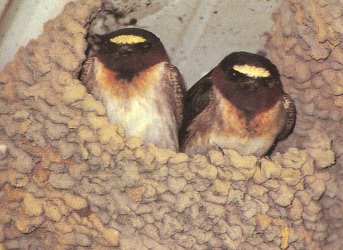
Challenge Question #12 asked: "List at least two or three special habitat needs of Cliff Swallows in their nesting area."
First graders Jack, Andrew and Megan of Ferrisburgh Central School in Vermont used their reasoning skills to come up with a great answer! They wrote, "Cliff Swallows need mud to build their nests. They will need to be near to the water and have some type of clay soil. When clay gets wet, it gets sticky. We are using clay at our school right now, and we have to get it wet in order for the pieces to stick together. The swallows have to build their nests somewhere that the nests can stay dry like under roofs.
Challenge Question #13 asked: "Why are all the mud pellets that make up a Cliff Swallow nest about the same size and shape?"
 |
|
Cliff Swallows |
All in the Muscles: Discussion of Challenge Question #14
"If a falcon caught a swallow, would its dinner be mainly red meat or white meat?"
Fifth Graders Andrew, Joseph, Ryan and Stephen of Ferrisburgh Central School wrote, "The meat would be mainly red because the swallows use their muscles a lot." That's precisely right! One ornithologist calculated that swallows fly about 600 miles a day just zipping around feeding, so every day is a long marathon for them, and their pectoral muscles need red fibers to keep from getting tired. Their leg muscles might have a lot of white muscle fibers, but their legs are so tiny and weak that a falcon would hardly taste them at all!
Please Report "Signs of Spring" From Your Part of the World!
 Report your "Signs of
Spring" sightings to Journey North. Report your "Signs of
Spring" sightings to Journey North. |
How to Respond to Today's Challenge Questions:
IMPORTANT: Answer only ONE question in each e-mail message.
1. Address an E-mail message to: jn-challenge-spring@learner.org
2. IMPORTANT: In the Subject Line of your message write:
Challenge Question #15 (OR #16).
3. In the body of the message, give your answer to the question above.
The Next Signs of Spring Update Will be Posted on April 5, 2002
Copyright 2002 Journey North. All Rights Reserved.
Please send all questions, comments, and suggestions to our feedback form
|
|
|
|
|
|
|
|