
James C. Leupold - USFWS
Home Page
Challenge Questions

Today's News

Spring's Journey North

Report Your Sightings


Search Journey North
return to:

 A/CPB
A/CPB


Robin Migration Update: April 22, 1998
Today's Report Includes:
- Happy Earth Day!
- Challenge Question #12
- Today's Migration Data
- Robins Arrive Across Alaska!
- Still Waiting for Robins?
- That's the Limit! Discussion of Challenge Question #11
Happy Earth Day!
All across the continent, from Alabama to Alaska, robins are singing today. But if it weren't for Rachel Carson--and her courage--the songs of spring wouldn't be what they are today.
 Rachel Carson wrote a landmark book called "Silent Spring".
In it she told the world about the dangers of chemical pesticides. She warned that many were poisonous and had
spread throughout the environment. Even the backyard robin was threatened. One example: Beginning in the spring
of 1955, as each wave of migrating robins appeared on the Michigan State Campus, they would die within a week.
People first suspected a disease, but after several years they concluded that, "in spite of the assurances
of the insecticide people that their sprays were harmless to birds, the robins were really dying of insecticidal
poisoning."
Rachel Carson wrote a landmark book called "Silent Spring".
In it she told the world about the dangers of chemical pesticides. She warned that many were poisonous and had
spread throughout the environment. Even the backyard robin was threatened. One example: Beginning in the spring
of 1955, as each wave of migrating robins appeared on the Michigan State Campus, they would die within a week.
People first suspected a disease, but after several years they concluded that, "in spite of the assurances
of the insecticide people that their sprays were harmless to birds, the robins were really dying of insecticidal
poisoning."This full story is told in Silent Spring. Find a copy and then see if you can answer this question:
Challenge Question #12
"If people weren't spraying robins directly with pesticides, exactly how did these chemicals kill the robins? (Please describe the process, step-by-step, in as much detail as you can.)
Remember: When you hear a robin singing in your backyard today, you have Rachel Carson to thank!
|
|
|
Lastest Migration Map |

According to observers in the far north, the robins have almost reached the end of the road. This morning, Bill
Shuster wrote from Seward:
"Robins started singing in town today. Though we have a few robins that stay the winter in Seward when they
start singing, or when I see flocks of Robins, this usually means the ones that migrate have returned." (wshuster@ptialaska.net)
 From nearby Homer, Alaska, Voznesenka Elementary/High School
reports: "Our school is at the very end of the road system at the southern end of the Kenai Peninsula. Our
first Robin of the spring was heard singing a welcoming song to us when we came to school on Tuesday, April 14."
From nearby Homer, Alaska, Voznesenka Elementary/High School
reports: "Our school is at the very end of the road system at the southern end of the Kenai Peninsula. Our
first Robin of the spring was heard singing a welcoming song to us when we came to school on Tuesday, April 14."
Carmen Field of the Alaska Maritime National Wildlife Refuge tells us more about robins in this region: "We
have a few robins here in Homer that over-winter. But we started seeing more about first week of April, and they
come in increasing numbers throughout the month of April and early May. So, though we really have some all year,
migrants started moving in from south first week of April."
Further inland in Anchorage, our official robin watchers at Sand Lake School reported on Monday:
"I'd say the wave of robins has arrived! Brandon saw two robins today; Willis saw five; Justin saw nine; Robert
and Yu saw one; Mr. Sterling saw two; Emi saw one.
"The first 3 robins were seen on April 6th, but then we saw nothing. We think there is a reasonable explanation:
We had a week of extremely SEVERE weather. The wind was just HOWLING here: 70 mph gusts, and steady winds in the
40's on the hillside. The wind was so strong that the entire city was complaining of lack of sleep because it buffeted
our houses so badly during the night. So, if there were any more than three robins in the city, they were hunkered
down like the rest of us.
"We live on the edge of two distinct weather zones here in Anchorage: To the west lies the Pacific Ocean,
to the east the vast interior of Alaska. The pressure differentials between the zones are big. When warm El Nino
waters and Pacific low pressure systems splash up against the Chugach Mountains and start to interact with the
high pressure systems of the interior, we get wind: honking winds; hold onto your hat, hunker down, wish you were
somewhere else winds. You've got to feel sorry for those vanguard robins--they must have been REALLY hungry."
(sterling@corecom.net)
Still Waiting for Robins....
"Robins DO go further north," writes Kipi Asicksik. "Shaktoolik is a small Eskimo village on Norton Sound (64.20N, - 161.9W). We have robins every summer. They are not plentiful, but they come. (kasicksik@shaktoolik.bssd.schoolzone.net)
No word yet of robins arriving in Fairbanks, and Kodiak has been waiting for 10,000 years for robins to fly the mere 15 extra miles to their island. Richard MacIntosh explains:
 |
"Islands tend to have fewer plant and animal species on them than adjacent mainlands. This is definitely true on Kodiak where we are lacking several species of birds, including robins (and White-crowned Sparrows and flycatchers) that are common on the adjacent mainland.
"In the last glacial period, some 10,000 years ago, robin habitat was probably enirely eliminated here by ice and snow. Why it has taken robins thousands of years to invade post-glacial Kodiak is a mystery to me. We are, however, on the verge of having them nest here, as we see and hear an occasional bird singing in the spring. All its going to take is for a female to find one of these singing males they will be on their way to populating (or perhaps re-populating) the island. I'm going to ask a bird expert in Anchorage to respond to you if she has any better ideas on why robins might be rare here."
(Richard.A.Macintosh@noaa.gov)
Finally, from her village at the tip of a peninsula on the Chukchi Sea, Sheila Gaquin reports from Point Hope, Alaska, "We have never seen robins in our area." (sgaquin@arctic.nsbsd.k12.ak.us)
You must be wondering why!
 |
|
Map by Claudia Fonkert |
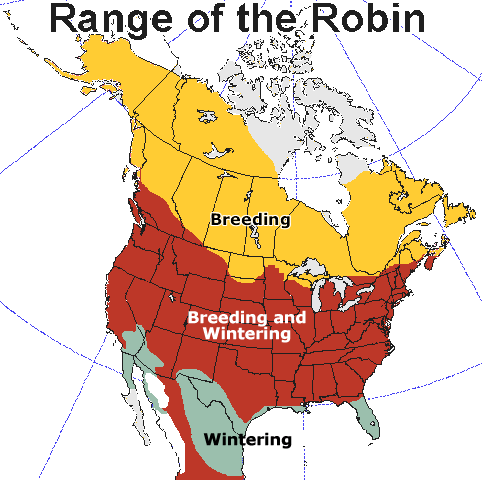
This range map shows the northern limits of robin nesting territory. Challenge Question # 11 asked, "Why don't robins go even further north? What factors influence the northern limits of their nesting range?"
From Isaac in Ms. Brundage's 5th grade class in Penobscot, ME: "Robins don't go further north because they cannot get worms in ice and snow-covered country and they don't like barren lands." (pes@penobscot.u93.k12,me.us )
Rose Wong from Iselin Middle School also thought this through: "We don't think robins go further north than places that reach the 36 degree isotherm.. When you go into the Northwest Territories and further north, you are in a Tundra Biome where the ground is permafrost. The factors that influence the northern limits of their nesting range are cold temperatures and no food. It is so cold, that the ground is permanently frozen. Worms could not dig out here and plants cannot grow. Without plants, there are no berries and the insects that eat the plants cannot live. Therefore, the robin could not survive." (susamel@juno.com)
"We see robins in the tundra near Seward, but suspect all nesting is lower in alders or trees in lower elevations," notes Bill Shuster. (wshuster@ptialaska.net)
Jeff Bouton of Fairbanks, Alaska suspects this is the case across Alaska:
"Robins are both ubiquitous and successful in nearly all habitats here in Alaska. If you look at the range map for this species in the National Geo Guide, you see they occur throughout the state except for the northernmost portion. This is the Arctic Coastal Plain and, as the name implies, there are no shrubs to speak of here.
"The shrubbery that is present is spread out, and usually quite short in height. While I've never seen Robins in my few visits to the Coastal Plain, I would not be surprised to see one here. They are regular through the north slope of the Brooks Range along stream beds and on the tundra alike where there are small willow patches.
"It seems that if there is food available and more than two or three willows (up to 4-5 foot in height) together, Robins can successfully nest.
"While they are not abundant in this habitat they are certainly regular and to be expected in nearly all habitats throughout the state. In my mind, it is simply the lack of taller willows that limits their breeding.
"Despite this there are no roads through most of Alaska, and places like the Arctic coast are extremely difficult and expensive to visit. As a result, our knowledge of the distribution of many species is inadequate to say the least, and I fully suspect the American Robin breeds all the way to the coast where it can find a toe hold. They are an extremely successful species. Hope this is helpful."
Jeff Bouton
Fairbanks, Alaska
jbouton@mosquitonet.com
How to Respond to Today's Challenge Question
1. Address an e-mail message to: jn-challenge-robin@learner.org
2. In the Subject Line of your message write: Challenge Question # 12
3. In the body of the message, answer today's question.
The Next Robin Migration Update Will be Posted on May 5, 1998.
Copyright 1998 Journey North. All Rights Reserved.